
Craftsmanship and Chess: Why a Board Demands More Than a Board
There's a German word that doesn't translate cleanly: Handwerkskunst. Not just craft, not just art — the space between. An object that has to function and is still allowed to be beautiful.
A chess set is exactly that. Maybe that's no accident — the game has always held a firm place in cultures that never fully separated tool from beauty.
Why a chess set demands real craft
You'd think a board is just a board. But the requirements are unusually demanding — and often contradictory.
It has to be precise: sixty-four squares, every one exactly the same size, in a perfect grid. A single millimeter off, and you notice immediately.
It has to be stable: wood moves, expanding with humidity and shrinking as it dries out. A board that warps is worthless.
It has to feel right: rounded edges, a matte finish, the correct weight in the hand.
And it has to be beautiful — without demanding attention. It shouldn't distract from the game itself.
Very few objects require all four qualities at once.
The inlay work: the real art
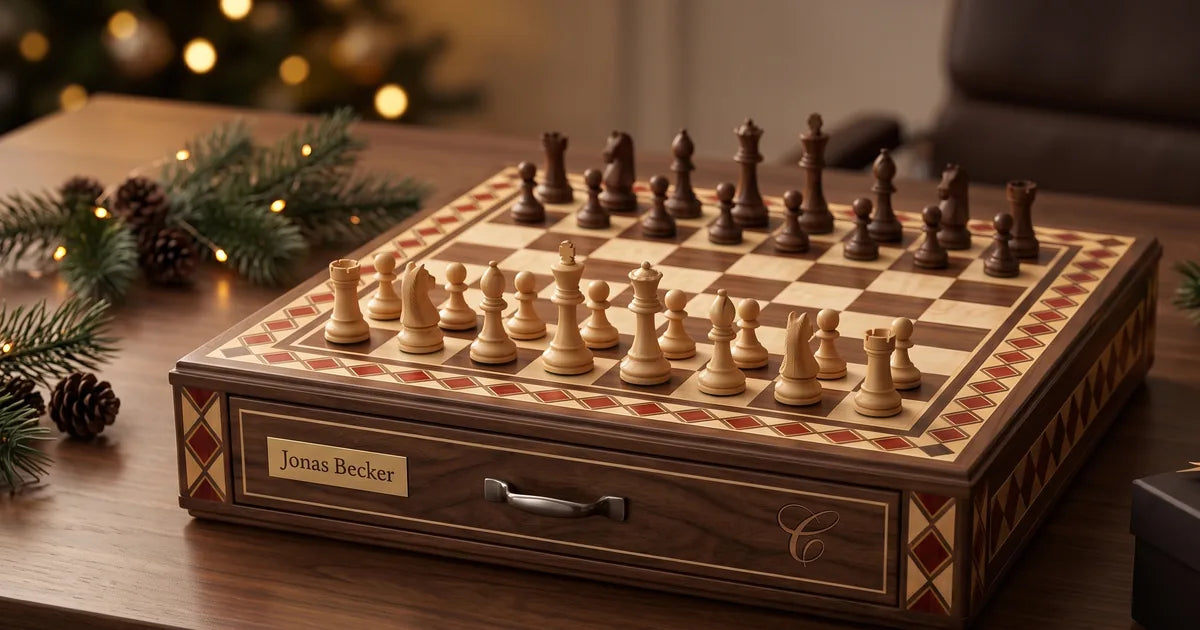
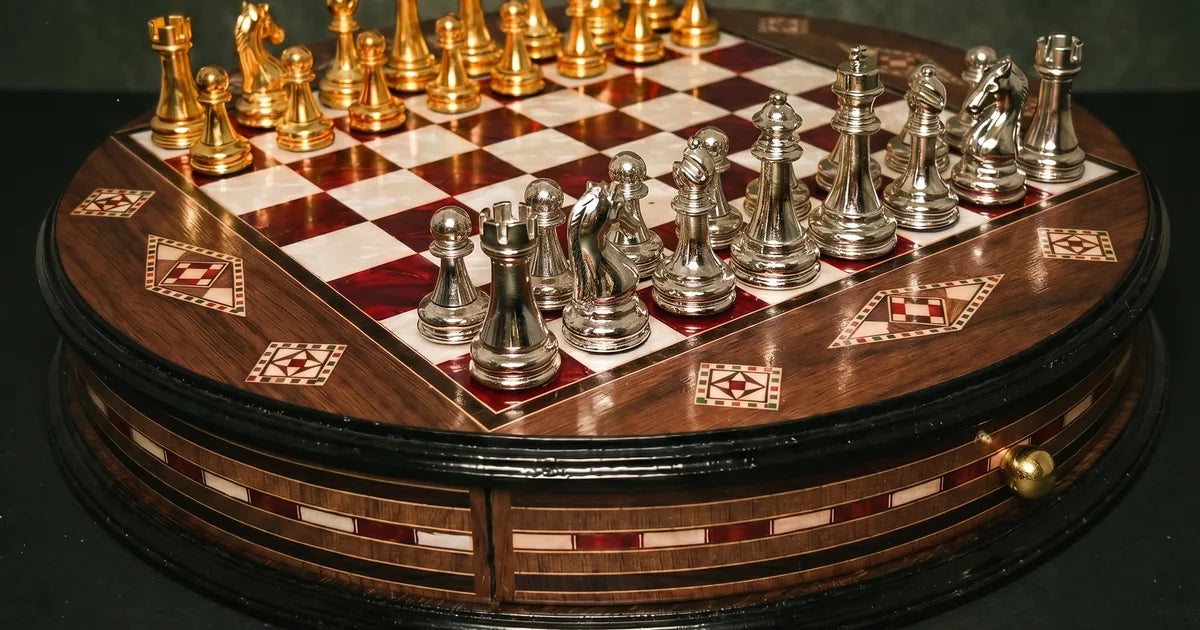
The most labor-intensive part of a good chess board is the part you notice least: the joins. Thirty-two light squares and thirty-two dark ones, each set in individually, edge to edge, with no visible seam.
Cheap production prints a pattern on, or presses a single sheet of veneer over the whole surface. With real inlay work, every square sits on its own — and that's exactly what you feel when you run a finger across it. You feel nothing. That's the whole point.
The knight as the true test
Every piece but one is shaped on a lathe — round, symmetrical, spun into form. Not the knight. It has to be carved.
That makes it the most honest test of craftsmanship there is. A hand-carved knight has expression: the mane has depth, the head has posture, the eye sits right. And here's the tell — the four knights in a genuine set are never identical. Small variations that show a person was actually at work.
What tradition actually means
Tradition often gets mistaken for being outdated. With craftsmanship, it's the reverse: tradition means a solution has proven itself across generations.
The Staunton design hasn't changed since 1849 — not out of stubbornness, but because it works. The proportion between square size and king height comes from millions of games. Solid wood gets used because it lasts.
None of it is nostalgia. It's accumulated knowledge that never needed replacing.
Why this matters more today than it used to
We live in an era where almost everything is made for quick use and quick disposal. Against that backdrop, an object that isn't — something with real weight, that ages instead of breaking down, that clearly took someone real time to make — stands out more than ever.
A handcrafted chess set is more than a game, then. It's a stance: the belief that some things are allowed to last.
Schachatelier: at home in Berlin
Schachatelier is at home in Berlin. Every set is genuinely handcrafted by experienced makers — in solid wood, with inlay work you can't feel and knights that get their character from a human hand.
→ Explore handcrafted chess sets
Frequently Asked Questions
What makes a chess set demanding to craft?
It has to be precise (64 perfectly matched squares), dimensionally stable (wood moves), correct to the touch, and aesthetically restrained — all at once. Very few objects require all four qualities simultaneously.
What is inlay work on a chess board?
Each of the 64 squares is set in individually, edge to edge, with no visible seam. Cheaper production instead prints the pattern on or presses a single sheet of veneer over the surface.
Why is the knight a sign of genuine handwork?
Because it's the only piece that can't be shaped on a lathe — it has to be carved. Hand-carved knights have real character and are never perfectly identical; machine-milled ones look uniform and lifeless.