
Handcrafted or Mass-Produced: How to Actually Tell the Difference
“Handcrafted“ gets stamped on almost everything these days — on bread baked from a frozen mix, on furniture off a factory line, on mass-produced chess sets. The word has taken a beating. But the real difference still exists — you just need to know where to look for it.
The knight gives everything away
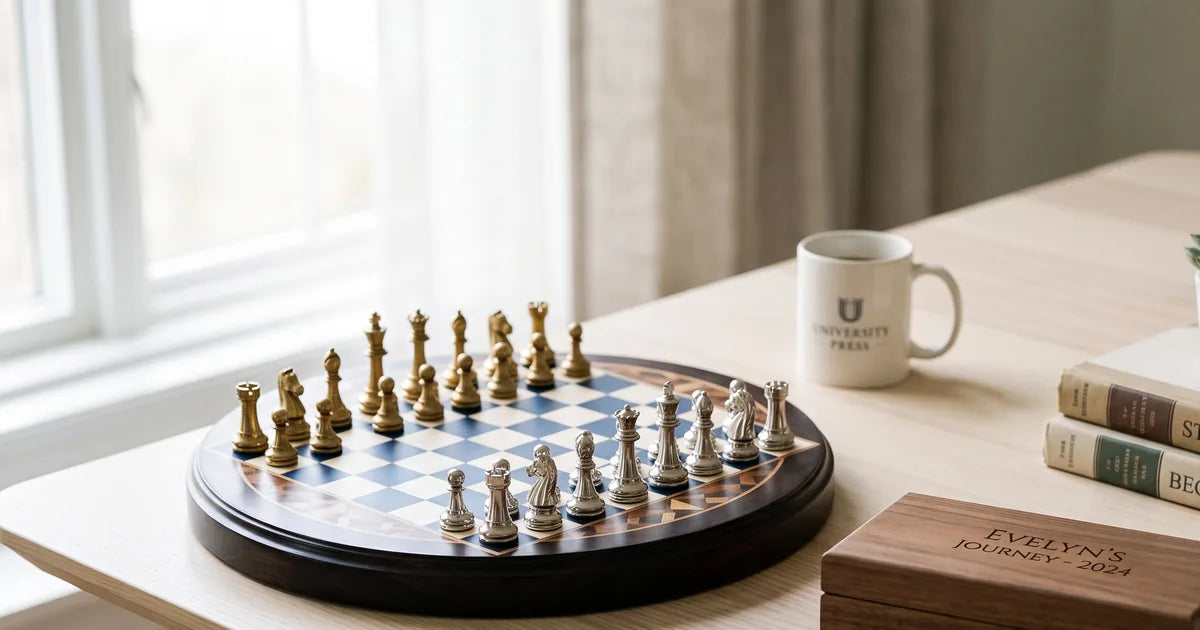
If you can only inspect one piece, make it the knight. It's the only piece that isn't round — every other piece is turned on a lathe; the knight can't be.
A hand-carved knight has expression. The mane has depth, the eye sits right, the head has posture. And here's the tell: the four knights in a genuinely handcrafted set are never identical. Small variations — that's not a flaw. That's the proof.
A machine-milled knight is perfect and lifeless. All four are exactly the same. The edges are clean, but nothing about it feels alive.
What machines actually do better
In fairness: not everything about handwork is superior. A CNC mill works more precisely than any human hand. It holds tolerances to a tenth of a millimeter, never has an off day, and repeats the same result a thousand times over.
That's why mass production isn't “bad“ either. It's just different. It delivers consistency — handwork delivers character.
The four places where handwork shows
The knight. See above. The most honest indicator.
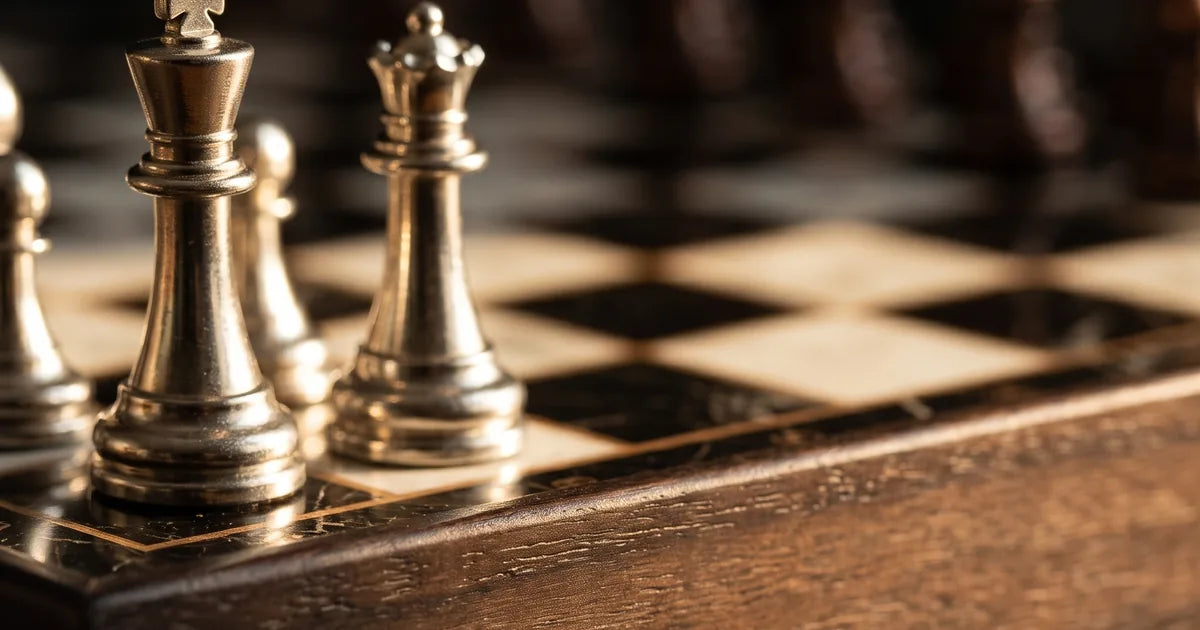
The board's edges. Hand-rounded edges feel soft and are minimally irregular. Machine-milled edges are exact — and exactly uninteresting.
The grain. With genuine handwork, wood is selected, not just allocated. A skilled maker places the most striking grain where it will actually be seen.
The finish. Hand-polished wood has a deep, matte glow. Machine-lacquered wood is glossy — flat and lifeless.
Why irregularity is a mark of quality
This is where a lot of people pause. We're trained to read perfection as quality. With craftsmanship, it's the opposite.
Two knights that look slightly different mean: someone sat down and carved these by hand. That small variation is the signature of the person who made the piece — and the reason no other set is exactly like yours.
What that means for value
Mass-produced pieces are replaceable — that's the whole point. Lose a pawn, buy a new one; it matches.
A handcrafted set isn't replaceable. That's inconvenient — and exactly why these pieces get passed down instead of thrown out. You don't replace them. You keep them.
At a Glance: What You Get with Schachatelier
For anyone who wants to see not just the craftsmanship details but also decide on a purchase, here are the key points at a glance — plainly and without detours.
| Feature | Schachatelier | Typical mass-produced sets |
|---|---|---|
| Craftsmanship | Handmade by experienced makers | Machine-based mass production |
| Personalization / Engraving | Possible on most sets | Usually unavailable or costs extra |
| Wood selection | Several wood types available (e.g. walnut, maple, sheesham) | Usually one standard wood type |
| Shipping (EU, Switzerland, UK, USA, Canada) | Free | Often costs extra |
| Packaging | Premium gift packaging | Standard cardboard box |
| Every set | Small natural variations — a true one-of-a-kind | Identical, mass-produced piece |
For more on the individual wood types, see our wood types comparison and our guide to wood combinations. We explain in detail why handcrafted sets are worth their price in our cost breakdown.
Schachatelier: at home in Berlin
Schachatelier is at home in Berlin. Every set is genuinely handcrafted by experienced makers — with knights whose character comes from a human hand, not a program.
→ Explore handcrafted chess sets
Frequently Asked Questions
How can you tell if a chess set is genuinely handcrafted?
Mostly by the knight: hand-carved, it has expression, and the four knights in a set are never exactly identical. Other signs include hand-rounded edges, deliberately chosen grain, and a deep, matte finish.
Is handwork always better than machine work?
Not in every respect. Machines work more precisely and consistently. Handwork, on the other hand, delivers character and individuality — no two sets are alike.
Why aren't handcrafted chess sets perfectly uniform?
Because a person made them. Small variations between pieces aren't a flaw — they're proof of genuine handwork, and the reason every set is one of a kind.
Does Schachatelier offer personalized engraving?
Yes, personal engraving is available on most sets — typically with a name, date, or short dedication.
Is shipping free with Schachatelier?
Yes, shipping is free within the EU as well as to Switzerland, the UK, the USA and Canada.